Anil Wipat
SBOL Chair (2015–2019) · Newcastle University
Publications and posts
Virtual Parts Repository 2: Model-Driven Design of Genetic Regulatory Circuits
Engineering genetic regulatory circuits is key to the creation of biological applications that are responsive to environmental changes. Computational models can assist in understanding especially large and complex circuits for which manual analysis is infeasible, permitting a model-driven design process. However, there…
Toward Full-Stack In Silico Synthetic Biology: Integrating Model Specification, Simulation, Verification, and Biological Compilation
We present the Infobiotics Workbench (IBW), a user-friendly, scalable, and integrated computational environment for the computer-aided design of synthetic biological systems. It supports an iterative workflow that begins with specification of the desired synthetic system, followed by simulation and verification of the…
Synthetic Biology Open Language Visual (SBOL Visual) Version 2.3
People who are engineering biological organisms often find it useful to communicate in diagrams, both about the structure of the nucleic acid sequences that they are engineering and about the functional relationships between sequence features and other molecular species. Some typical practices and conventions have…
Capturing Multicellular System Designs Using Synthetic Biology Open Language (SBOL)
Synthetic biology aims to develop novel biological systems and increase their reproducibility using engineering principles such as standardization and modularization. It is important that these systems can be represented and shared in a standard way to ensure they can be easily understood, reproduced, and utilized by…
Synthetic Biology Open Language Visual (SBOL Visual) Version 2.2
People who are engineering biological organisms often find it useful to communicate in diagrams, both about the structure of the nucleic acid sequences that they are engineering and about the functional relationships between sequence features and other molecular species. Some typical practices and conventions have…
SBOL Visual 2 Ontology
Standardizing the visual representation of genetic parts and circuits is essential for unambiguously creating and interpreting genetic designs. To this end, an increasing number of tools are adopting well-defined glyphs from the Synthetic Biology Open Language (SBOL) Visual standard to represent various genetic parts…
SBOL Visual 2 Ontology
Standardizing the visual representation of genetic parts and circuits is essential for unambiguously creating and interpreting genetic designs. To this end, an increasing number of tools are adopting well-defined glyphs from the Synthetic Biology Open Language (SBOL) Visual standard to represent various genetic parts…
ShortBOL: A Language for Scripting Designs for Engineered Biological Systems Using Synthetic Biology Open Language (SBOL)
The Synthetic Biology Open Language (SBOL) is an emerging synthetic biology data exchange standard, designed primarily for unambiguous and efficient machine-to-machine communication. However, manual editing of SBOL is generally difficult for nontrivial designs. Here, we describe ShortBOL, a lightweight SBOL scripting…
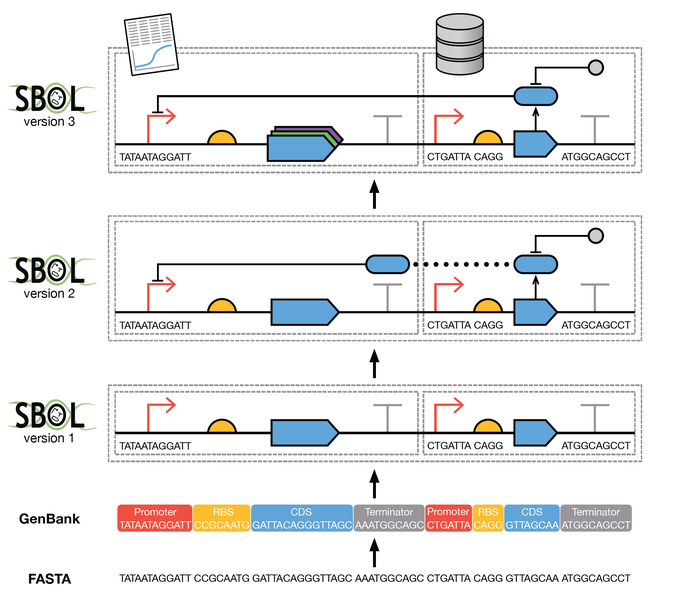
Synthetic biology open language (SBOL) version 3.0.0
Synthetic biology builds upon genetics, molecular biology, and metabolic engineering by applying engineering principles to the design of biological systems. When designing a synthetic system, synthetic biologists need to exchange information about multiple types of molecules, the intended behavior of the system, and…
Synthetic biology open language visual (SBOL visual) version 2.2
People who are engineering biological organisms often find it useful to communicate in diagrams, both about the structure of the nucleic acid sequences that they are engineering and about the functional relationships between sequence features and other molecular species. Some typical practices and conventions have…
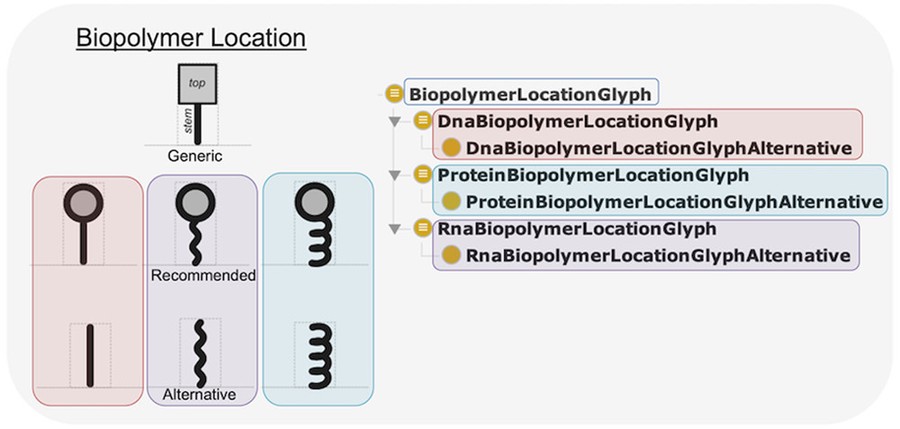
SBOL Visual 2 Ontology
Standardizing the visual representation of genetic parts and circuits is essential for unambiguously creating and interpreting genetic designs. To this end, an increasing number of tools are adopting well-defined glyphs from the Synthetic Biology Open Language (SBOL) Visual standard to represent various genetic parts…
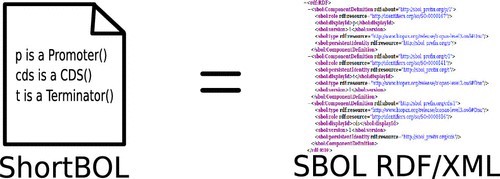
ShortBOL: A Language for Scripting Designs for Engineered Biological Systems Using Synthetic Biology Open Language (SBOL)
The Synthetic Biology Open Language (SBOL) is an emerging synthetic biology data exchange standard, designed primarily for unambiguous and efficient machine-to-machine communication. However, manual editing of SBOL is generally difficult for nontrivial designs. Here, we describe ShortBOL, a lightweight SBOL scripting…
The Synthetic Biology Open Language (SBOL) Version 3: Simplified Data Exchange for Bioengineering
The Synthetic Biology Open Language (SBOL) is a community-developed data standard that allows knowledge about biological designs to be captured using a machine-tractable, ontology-backed representation that is built using Semantic Web technologies. While early versions of SBOL focused only on the description of…
The Synthetic Biology Open Language (SBOL) Version 3: Simplified Data Exchange for Bioengineering
The Synthetic Biology Open Language (SBOL) is a community-developed data standard that allows knowledge about biological designs to be captured using a machine-tractable, ontology-backed representation that is built using Semantic Web technologies. While early versions of SBOL focused only on the description of…
Communicating Structure and Function in Synthetic Biology Diagrams
Biological engineers often find it useful to communicate using diagrams. These diagrams can include information both about the structure of the nucleic acid sequences they are engineering and about the functional relationships between features of these sequences and/or other molecular species. A number of conventions…
Communicating Structure and Function in Synthetic Biology Diagrams
Biological engineers often find it useful to communicate using diagrams. These diagrams can include information both about the structure of the nucleic acid sequences they are engineering and about the functional relationships between features of these sequences and/or other molecular species. A number of conventions…
A Computational Workflow for the Automated Generation of Models of Genetic Designs
Computational models are essential to engineer predictable biological systems and to scale up this process for complex systems. Computational modeling often requires expert knowledge and data to build models. Clearly, manual creation of models is not scalable for large designs. Despite several automated model…
SBOL-OWL: An Ontological Approach for Formal and Semantic Representation of Synthetic Biology Information
Standard representation of data is key for the reproducibility of designs in synthetic biology. The Synthetic Biology Open Language (SBOL) has already emerged as a data standard to represent information about genetic circuits, and it is based on capturing data using graphs. The language provides the syntax using a free…
A Computational Workflow for the Automated Generation of Models of Genetic Designs
Computational models are essential to engineer predictable biological systems and to scale up this process for complex systems. Computational modeling often requires expert knowledge and data to build models. Clearly, manual creation of models is not scalable for large designs. Despite several automated model…
SBOL-OWL: An Ontological Approach for Formal and Semantic Representation of Synthetic Biology Information
Standard representation of data is key for the reproducibility of designs in synthetic biology. The Synthetic Biology Open Language (SBOL) has already emerged as a data standard to represent information about genetic circuits, and it is based on capturing data using graphs. The language provides the syntax using a free…
Synthetic Biology Open Language (SBOL) Version 2.3
textlesssection class=\"abstract\"textgreatertextlessh2 class=\"abstractTitle text-title my-1\" id=\"d230e2\"textgreaterAbstracttextless/h2textgreatertextlessptextgreaterSynthetic biology builds upon the techniques and successes of genetics, molecular biology, and metabolic engineering by applying engineering…
Synthetic Biology Open Language Visual (SBOL Visual) Version 2.1
Abstract People who are engineering biological organisms often find it useful to communicate in diagrams, both about the structure of the nucleic acid sequences that they are engineering and about the functional relationships between sequence features and other molecular species . Some typical practices and…
Synthetic Biology Open Language (SBOL) Version 2.3
Synthetic biology builds upon the techniques and successes of genetics, molecular biology, and metabolic engineering by applying engineering principles to the design of biological systems. The field still faces substantial challenges, including long development times, high rates of failure, and poor reproducibility.…
Synthetic Biology Open Language Visual (SBOL Visual) Version 2.1
People who are engineering biological organisms often find it useful to communicate in diagrams, both about the structure of the nucleic acid sequences that they are engineering and about the functional relationships between sequence features and other molecular species . Some typical practices and conventions have…
sboljs: Bringing the Synthetic Biology Open Language to the Web Browser
The Synthetic Biology Open Language (SBOL) is a data standard for the representation of engineered biological systems. SBOL is implemented in the form of software libraries which can be used to add SBOL support to both new and existing software tools. While existing libraries allow for software to be developed that…
Sboljs: Bringing the Synthetic Biology Open Language to the Web Browser
The Synthetic Biology Open Language (SBOL) is a data standard for the representation of engineered biological systems. SBOL is implemented in the form of software libraries which can be used to add SBOL support to both new and existing software tools. While existing libraries allow for software to be developed that…
SynBioHub: A Standards-Enabled Design Repository for Synthetic Biology
The SynBioHub repository (https://synbiohub.org) is an open-source software project that facilitates the sharing of information about engineered biological systems. SynBioHub provides computational access for software and data integration, and a graphical user interface that enables users to search for and share…
SynBioHub: A Standards-Enabled Design Repository for Synthetic Biology
The SynBioHub repository (https://synbiohub.org) is an open-source software project that facilitates the sharing of information about engineered biological systems. SynBioHub provides computational access for software and data integration, and a graphical user interface that enables users to search for and share…
A Visual Language for Protein Design
As protein engineering becomes more sophisticated, practitioners increasingly need to share diagrams for communicating protein designs. To this end, we present a draft visual language, Protein Language, that describes the high-level architecture of an engineered protein with easy-to-draw glyphs, intended to be…
SBOLDesigner 2: An Intuitive Tool for Structural Genetic Design
As the Synthetic Biology Open Language (SBOL) data and visual standards gain acceptance for describing genetic designs in a detailed and reproducible way, there is an increasing need for an intuitive sequence editor tool that biologists can use that supports these standards. This paper describes SBOLDesigner 2, a…
A Visual Language for Protein Design
As protein engineering becomes more sophisticated, practitioners increasingly need to share diagrams for communicating protein designs. To this end, we present a draft visual language, Protein Language, that describes the high-level architecture of an engineered protein with easy-to-draw glyphs, intended to be…
SBOLDesigner 2: An Intuitive Tool for Structural Genetic Design
As the Synthetic Biology Open Language (SBOL) data and visual standards gain acceptance for describing genetic designs in a detailed and reproducible way, there is an increasing need for an intuitive sequence editor tool that biologists can use that supports these standards. This paper describes SBOLDesigner 2, a…
A standard-enabled workflow for synthetic biology
A synthetic biology workflow is composed of data repositories that provide information about genetic parts, sequence-level design tools to compose these parts into circuits, visualization tools to depict these designs, genetic design tools to select parts to create systems, and modeling and simulation tools to evaluate…
A Standard-Enabled Workflow for Synthetic Biology
A synthetic biology workflow is composed of data repositories that provide information about genetic parts, sequence-level design tools to compose these parts into circuits, visualization tools to depict these designs, genetic design tools to select parts to create systems, and modeling and simulation tools to evaluate…
Data Integration and Mining for Synthetic Biology Design
One aim of synthetic biologists is to create novel and predictable biological systems from simpler modular parts. This approach is currently hampered by a lack of well-defined and characterized parts and devices. However, there is a wealth of existing biological information, which can be used to identify and…
Data Integration and Mining for Synthetic Biology Design
One aim of synthetic biologists is to create novel and predictable biological systems from simpler modular parts. This approach is currently hampered by a lack of well-defined and characterized parts and devices. However, there is a wealth of existing biological information, which can be used to identify and…
Synthetic Biology Open Language (SBOL) Version 2.1.0
textlesssection class=\"abstract\"textgreatertextlessh2 class=\"abstractTitle text-title my-1\" id=\"d807e2\"textgreaterSummarytextless/h2textgreatertextlessptextgreaterSynthetic biology builds upon the techniques and successes of genetics, molecular biology, and metabolic engineering by applying engineering principles…
Synthetic Biology Open Language (SBOL) Version 2.1.0
Synthetic biology builds upon the techniques and successes of genetics, molecular biology, and metabolic engineering by applying engineering principles to the design of biological systems. The field still faces substantial challenges, including long development times, high rates of failure, and poor reproducibility.…
VisBOL: Web-Based Tools for Synthetic Biology Design Visualization
VisBOL is a Web-based application that allows the rendering of genetic circuit designs, enabling synthetic biologists to visually convey designs in SBOL visual format. VisBOL designs can be exported to formats including PNG and SVG images to be embedded in Web pages, presentations and publications. The VisBOL tool…
VisBOL: Web-Based Tools for Synthetic Biology Design Visualization
VisBOL is a Web-based application that allows the rendering of genetic circuit designs, enabling synthetic biologists to visually convey designs in SBOL visual format. VisBOL designs can be exported to formats including PNG and SVG images to be embedded in Web pages, presentations and publications. The VisBOL tool…
Sharing Structure and Function in Biological Design with SBOL 2.0
The Synthetic Biology Open Language (SBOL) is a standard that enables collaborative engineering of biological systems across different institutions and tools. SBOL is developed through careful consideration of recent synthetic biology trends, real use cases, and consensus among leading researchers in the field and…
The SBOL Stack: A Platform for Storing, Publishing, and Sharing Synthetic Biology Designs
Recently, synthetic biologists have developed the Synthetic Biology Open Language (SBOL), a data exchange standard for descriptions of genetic parts, devices, modules, and systems. The goals of this standard are to allow scientists to exchange designs of biological parts and systems, to facilitate the storage of…
Sharing Structure and Function in Biological Design with SBOL 2.0
The Synthetic Biology Open Language (SBOL) is a standard that enables collaborative engineering of biological systems across different institutions and tools. SBOL is developed through careful consideration of recent synthetic biology trends, real use cases, and consensus among leading researchers in the field and…
The SBOL Stack: A Platform for Storing, Publishing, and Sharing Synthetic Biology Designs
Recently, synthetic biologists have developed the Synthetic Biology Open Language (SBOL), a data exchange standard for descriptions of genetic parts, devices, modules, and systems. The goals of this standard are to allow scientists to exchange designs of biological parts and systems, to facilitate the storage of…
SBOL Visual: A Graphical Language for Genetic Designs
Synthetic Biology Open Language (SBOL) Visual is a graphical standard for genetic engineering. It consists of symbols representing DNA subsequences, including regulatory elements and DNA assembly features. These symbols can be used to draw illustrations for communication and instruction, and as image assets for…
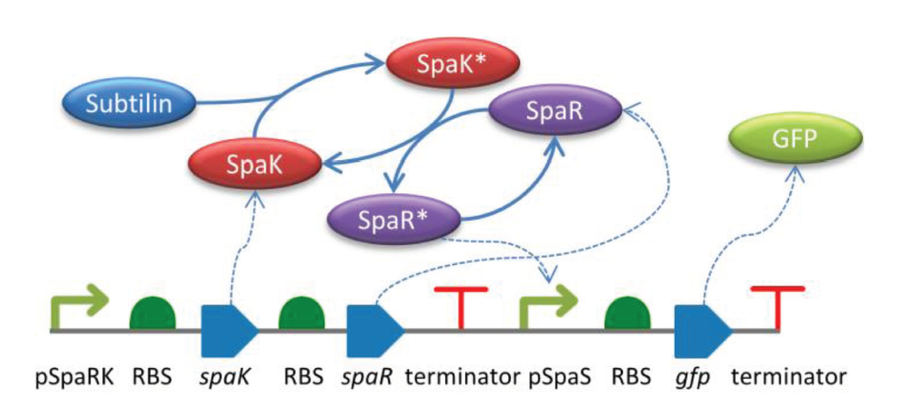
Composable Modular Models for Synthetic Biology
Modelling and computational simulation are crucial for the large-scale engineering of biological circuits since they allow the system under design to be simulated prior to implementation in vivo. To support automated, model-driven design it is desirable that in silico models are modular, composable and use standard…
libSBOLj 2.0: A Java Library to Support SBOL 2.0
The Synthetic Biology Open Language (SBOL) is an emerging data standard for representing synthetic biology designs. The goal of SBOL is to improve the reproducibility of these designs and their electronic exchange between researchers and/or genetic design automation tools. The latest version of the standard, SBOL 2.0,…
SBOL Visual: A Graphical Language for Genetic Designs
Synthetic Biology Open Language (SBOL) Visual is a graphical standard for genetic engineering. It consists of symbols representing DNA subsequences, including regulatory elements and DNA assembly features. These symbols can be used to draw illustrations for communication and instruction, and as image assets for…
BBF RFC 108: Synthetic Biology Open Language (SBOL) Version 2.0.0
The Synthetic Biology Open Language (SBOL) has been developed as a standard to support the specification and exchange of biological design information in synthetic biology, filling a need not satisfied by other pre-existing standards.
BBF RFC 108: Synthetic Biology Open Language (SBOL) Version 2.0.0
The Synthetic Biology Open Language (SBOL) has been developed as a standard to support the specification and exchange of biological design information in synthetic biology, filling a need not satisfied by other pre-existing standards.
The Synthetic Biology Open Language (SBOL) provides a community standard for communicating designs in synthetic biology
The synthetic biology research community describes a standard language for exchanging designs of biological 'parts'.
The Synthetic Biology Open Language (SBOL) Provides a Community Standard for Communicating Designs in Synthetic Biology
The synthetic biology research community describes a standard language for exchanging designs of biological 'parts'.
Synthetic Biology Open Language (SBOL) Version 1.1.0
In this BioBricks Foundation Request for Comments (BBF RFC), we specify the Synthetic Biology Open Language (SBOL) Version 1.1.0 to enable the electronic exchange of information describing DNA components used in synthetic biology. We define: 1. the vocabulary, a set of preferred terms and 2. the core data model, a…
Synthetic Biology Open Language (SBOL) Version 1.1.0
In this BioBricks Foundation Request for Comments (BBF RFC), we specify the Synthetic Biology Open Language (SBOL) Version 1.1.0 to enable the electronic exchange of information describing DNA components used in synthetic biology. We define: 1. the vocabulary, a set of preferred terms and 2. the core data model, a…
Title: Synthetic Biology Open Language (SBOL) Version 1.0.0
In this BioBricks Foundation Request for Comments (BBF RFC), we specify the Synthetic Biology Open Language (SBOL) Version 1.0.0 to enable the electronic exchange of information describing DNA components used in synthetic biology. We define: 1. the vocabulary, a set of preferred terms and 2. the core data…
Title: Synthetic Biology Open Language (SBOL) Version 1.0.0
In this BioBricks Foundation Request for Comments (BBF RFC), we specify the Synthetic Biology Open Language (SBOL) Version 1.0.0 to enable the electronic exchange of information describing DNA components used in synthetic biology. We define: 1. the vocabulary, a set of preferred terms and 2. the core data…