Chris J. Myers
Publications and posts
Synthetic Biology Curation Tools (SYNBICT)
Much progress has been made in developing tools to generate component-based design representations of biological systems from standard libraries of parts. Most biological designs, however, are still specified at the sequence level. Consequently, there exists a need for a tool that can be used to automatically infer…
Curation Principles Derived from the Analysis of the SBOL iGEM Data Set
As an engineering endeavor, synthetic biology requires effective sharing of genetic design information that can be reused in the construction of new designs. While there are a number of large community repositories of design information, curation of this information has been limited. This in turn limits the ways in…
Stochastic Hazard Analysis of Genetic Circuits in iBioSim and STAMINA
In synthetic biology, combinational circuits are used to program cells for various new applications like biosensors, drug delivery systems, and biofuels. Similar to asynchronous electronic circuits, some combinational genetic circuits may show unwanted switching variations (glitches) caused by multiple input changes.…
Synthetic Biology Knowledge System
The Synthetic Biology Knowledge System (SBKS) is an instance of the SynBioHub repository that includes text and data information that has been mined from papers published in ACS Synthetic Biology. This paper describes the SBKS curation framework that is being developed to construct the knowledge stored in this…
VisBOL2—Improving Web-Based Visualization for Synthetic Biology Designs
VisBOL is a web-based visualization tool used to depict genetic circuit designs. This tool depicts simple DNA circuits adequately, but it has become increasingly outdated as new versions of SBOL Visual were released. This paper introduces VisBOL2, a heavily redesigned version of VisBOL that makes a number of…
SBOLCanvas: A Visual Editor for Genetic Designs
SBOLCanvas is a web-based application that can create and edit genetic constructs using the SBOL data and visual standards. SBOLCanvas allows a user to create a genetic design visually and structurally from start to finish. It also allows users to incorporate existing SBOL data from a SynBioHub repository. By the…
SBOL Visual 2 Ontology
Standardizing the visual representation of genetic parts and circuits is essential for unambiguously creating and interpreting genetic designs. To this end, an increasing number of tools are adopting well-defined glyphs from the Synthetic Biology Open Language (SBOL) Visual standard to represent various genetic parts…
SBOL Visual 2 Ontology
Standardizing the visual representation of genetic parts and circuits is essential for unambiguously creating and interpreting genetic designs. To this end, an increasing number of tools are adopting well-defined glyphs from the Synthetic Biology Open Language (SBOL) Visual standard to represent various genetic parts…
The Synthetic Biology Open Language (SBOL) Version 3: Simplified Data Exchange for Bioengineering
The Synthetic Biology Open Language (SBOL) is a community-developed data standard that allows knowledge about biological designs to be captured using a machine-tractable, ontology-backed representation that is built using Semantic Web technologies. While early versions of SBOL focused only on the description of…
The Synthetic Biology Open Language (SBOL) Version 3: Simplified Data Exchange for Bioengineering
The Synthetic Biology Open Language (SBOL) is a community-developed data standard that allows knowledge about biological designs to be captured using a machine-tractable, ontology-backed representation that is built using Semantic Web technologies. While early versions of SBOL focused only on the description of…
pySBOL: A Python Package for Genetic Design Automation and Standardization
This paper presents pySBOL, a software library for computer-aided design of synthetic biological systems in the Python scripting language. This library provides an easy-to-use, object-oriented, application programming interface (API) with low barrier of entry for synthetic biology application developers. The pySBOL…
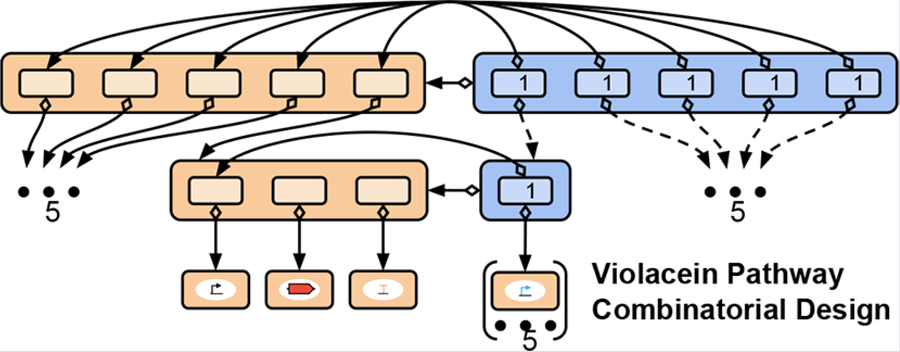
Specifying Combinatorial Designs with the Synthetic Biology Open Language (SBOL)
As improvements in DNA synthesis technology and assembly methods make combinatorial assembly of genetic constructs increasingly accessible, methods for representing genetic constructs likewise need to improve to handle the exponential growth of combinatorial design space. To this end, we present a community accepted…
Design of Asynchronous Genetic Circuits
Most digital electronic circuits utilize a timing reference to synchronize the progression of signals and enable sequential memory elements. These designs may not be realizable in biological substrates due to the lack of a reliable high-frequency clock signal. Asynchronous designs eliminate the need for a clock with…
Design of Asynchronous Genetic Circuits
Most digital electronic circuits utilize a timing reference to synchronize the progression of signals and enable sequential memory elements. These designs may not be realizable in biological substrates due to the lack of a reliable high-frequency clock signal. Asynchronous designs eliminate the need for a clock with…
pySBOL: A Python Package for Genetic Design Automation and Standardization
This paper presents pySBOL, a software library for computer-aided design of synthetic biological systems in the Python scripting language. This library provides an easy-to-use, object-oriented, application programming interface (API) with low barrier of entry for synthetic biology application developers. The pySBOL…
Specifying Combinatorial Designs with the Synthetic Biology Open Language (SBOL)
As improvements in DNA synthesis technology and assembly methods make combinatorial assembly of genetic constructs increasingly accessible, methods for representing genetic constructs likewise need to improve to handle the exponential growth of combinatorial design space. To this end, we present a community accepted…
sboljs: Bringing the Synthetic Biology Open Language to the Web Browser
The Synthetic Biology Open Language (SBOL) is a data standard for the representation of engineered biological systems. SBOL is implemented in the form of software libraries which can be used to add SBOL support to both new and existing software tools. While existing libraries allow for software to be developed that…
Sboljs: Bringing the Synthetic Biology Open Language to the Web Browser
The Synthetic Biology Open Language (SBOL) is a data standard for the representation of engineered biological systems. SBOL is implemented in the form of software libraries which can be used to add SBOL support to both new and existing software tools. While existing libraries allow for software to be developed that…
SynBioHub: A Standards-Enabled Design Repository for Synthetic Biology
The SynBioHub repository (https://synbiohub.org) is an open-source software project that facilitates the sharing of information about engineered biological systems. SynBioHub provides computational access for software and data integration, and a graphical user interface that enables users to search for and share…
SynBioHub: A Standards-Enabled Design Repository for Synthetic Biology
The SynBioHub repository (https://synbiohub.org) is an open-source software project that facilitates the sharing of information about engineered biological systems. SynBioHub provides computational access for software and data integration, and a graphical user interface that enables users to search for and share…
A Validator and Converter for the Synthetic Biology Open Language
This paper presents a new validation and conversion utility for the Synthetic Biology Open Language (SBOL). This utility can be accessed directly in software using the libSBOLj library, through a web interface, or using a web service via RESTful API calls. The validator checks all required and best practice rules set…
SBOLDesigner 2: An Intuitive Tool for Structural Genetic Design
As the Synthetic Biology Open Language (SBOL) data and visual standards gain acceptance for describing genetic designs in a detailed and reproducible way, there is an increasing need for an intuitive sequence editor tool that biologists can use that supports these standards. This paper describes SBOLDesigner 2, a…
A Validator and Converter for the Synthetic Biology Open Language
This paper presents a new validation and conversion utility for the Synthetic Biology Open Language (SBOL). This utility can be accessed directly in software using the libSBOLj library, through a web interface, or using a web service via RESTful API calls. The validator checks all required and best practice rules set…
SBOLDesigner 2: An Intuitive Tool for Structural Genetic Design
As the Synthetic Biology Open Language (SBOL) data and visual standards gain acceptance for describing genetic designs in a detailed and reproducible way, there is an increasing need for an intuitive sequence editor tool that biologists can use that supports these standards. This paper describes SBOLDesigner 2, a…
A standard-enabled workflow for synthetic biology
A synthetic biology workflow is composed of data repositories that provide information about genetic parts, sequence-level design tools to compose these parts into circuits, visualization tools to depict these designs, genetic design tools to select parts to create systems, and modeling and simulation tools to evaluate…
A Standard-Enabled Workflow for Synthetic Biology
A synthetic biology workflow is composed of data repositories that provide information about genetic parts, sequence-level design tools to compose these parts into circuits, visualization tools to depict these designs, genetic design tools to select parts to create systems, and modeling and simulation tools to evaluate…
SBOLme: a Repository of SBOL Parts for Metabolic Engineering
The Synthetic Biology Open Language (SBOL) is a community-driven open language to promote standardization in synthetic biology. To support the use of SBOL in metabolic engineering, we developed SBOLme, the first open-access repository of SBOL 2-compliant biochemical parts for a wide range of metabolic engineering…
SBOLme: A Repository of SBOL Parts for Metabolic Engineering
The Synthetic Biology Open Language (SBOL) is a community-driven open language to promote standardization in synthetic biology. To support the use of SBOL in metabolic engineering, we developed SBOLme, the first open-access repository of SBOL 2-compliant biochemical parts for a wide range of metabolic engineering…
A Converter from the Systems Biology Markup Language to the Synthetic Biology Open Language
Standards are important to synthetic biology because they enable exchange and reproducibility of genetic designs. This paper describes a procedure for converting between two standards: the Systems Biology Markup Language (SBML) and the Synthetic Biology Open Language (SBOL). SBML is a standard for behavioral models of…
Sharing Structure and Function in Biological Design with SBOL 2.0
The Synthetic Biology Open Language (SBOL) is a standard that enables collaborative engineering of biological systems across different institutions and tools. SBOL is developed through careful consideration of recent synthetic biology trends, real use cases, and consensus among leading researchers in the field and…
A Converter from the Systems Biology Markup Language to the Synthetic Biology Open Language
Standards are important to synthetic biology because they enable exchange and reproducibility of genetic designs. This paper describes a procedure for converting between two standards: the Systems Biology Markup Language (SBML) and the Synthetic Biology Open Language (SBOL). SBML is a standard for behavioral models of…
Sharing Structure and Function in Biological Design with SBOL 2.0
The Synthetic Biology Open Language (SBOL) is a standard that enables collaborative engineering of biological systems across different institutions and tools. SBOL is developed through careful consideration of recent synthetic biology trends, real use cases, and consensus among leading researchers in the field and…
SBOL Visual: A Graphical Language for Genetic Designs
Synthetic Biology Open Language (SBOL) Visual is a graphical standard for genetic engineering. It consists of symbols representing DNA subsequences, including regulatory elements and DNA assembly features. These symbols can be used to draw illustrations for communication and instruction, and as image assets for…
libSBOLj 2.0: A Java Library to Support SBOL 2.0
The Synthetic Biology Open Language (SBOL) is an emerging data standard for representing synthetic biology designs. The goal of SBOL is to improve the reproducibility of these designs and their electronic exchange between researchers and/or genetic design automation tools. The latest version of the standard, SBOL 2.0,…
SBOL Visual: A Graphical Language for Genetic Designs
Synthetic Biology Open Language (SBOL) Visual is a graphical standard for genetic engineering. It consists of symbols representing DNA subsequences, including regulatory elements and DNA assembly features. These symbols can be used to draw illustrations for communication and instruction, and as image assets for…
Generating Systems Biology Markup Language Models from the Synthetic Biology Open Language
In the context of synthetic biology, model generation is the automated process of constructing biochemical models based on genetic designs. This paper discusses the use cases for model generation in genetic design automation (GDA) software tools and introduces the foundational concepts of standards and model annotation…
Generating Systems Biology Markup Language Models from the Synthetic Biology Open Language
In the context of synthetic biology, model generation is the automated process of constructing biochemical models based on genetic designs. This paper discusses the use cases for model generation in genetic design automation (GDA) software tools and introduces the foundational concepts of standards and model annotation…
Directed Acyclic Graph-Based Technology Mapping of Genetic Circuit Models
As engineering foundations such as standards and abstraction begin to mature within synthetic biology, it is vital that genetic design automation (GDA) tools be developed to enable synthetic biologists to automatically select standardized DNA components from a library to meet the behavioral specification for a genetic…
Directed Acyclic Graph-Based Technology Mapping of Genetic Circuit Models
As engineering foundations such as standards and abstraction begin to mature within synthetic biology, it is vital that genetic design automation (GDA) tools be developed to enable synthetic biologists to automatically select standardized DNA components from a library to meet the behavioral specification for a genetic…
The Synthetic Biology Open Language (SBOL) provides a community standard for communicating designs in synthetic biology
The synthetic biology research community describes a standard language for exchanging designs of biological 'parts'.
The Synthetic Biology Open Language (SBOL) Provides a Community Standard for Communicating Designs in Synthetic Biology
The synthetic biology research community describes a standard language for exchanging designs of biological 'parts'.
A Methodology to Annotate Systems Biology Markup Language Models with the Synthetic Biology Open Language
Recently, we have begun to witness the potential of synthetic biology, noted here in the form of bacteria and yeast that have been genetically engineered to produce biofuels, manufacture drug precursors, and even invade tumor cells. The success of these projects, however, has often failed in translation and application…
A Methodology to Annotate Systems Biology Markup Language Models with the Synthetic Biology Open Language
Recently, we have begun to witness the potential of synthetic biology, noted here in the form of bacteria and yeast that have been genetically engineered to produce biofuels, manufacture drug precursors, and even invade tumor cells. The success of these projects, however, has often failed in translation and application…
Dynamic Modeling of Cellular Populations within iBioSim
As the complexity of synthetic genetic circuits increases, modeling is becoming a necessary first step to inform subsequent experimental efforts. In recent years, the design automation community has developed a wealth of computational tools for assisting experimentalists in designing and analyzing new genetic circuits…
Dynamic Modeling of Cellular Populations within iBioSim
As the complexity of synthetic genetic circuits increases, modeling is becoming a necessary first step to inform subsequent experimental efforts. In recent years, the design automation community has developed a wealth of computational tools for assisting experimentalists in designing and analyzing new genetic circuits…
Synthetic Biology Open Language (SBOL) Version 1.1.0
In this BioBricks Foundation Request for Comments (BBF RFC), we specify the Synthetic Biology Open Language (SBOL) Version 1.1.0 to enable the electronic exchange of information describing DNA components used in synthetic biology. We define: 1. the vocabulary, a set of preferred terms and 2. the core data model, a…
Synthetic Biology Open Language (SBOL) Version 1.1.0
In this BioBricks Foundation Request for Comments (BBF RFC), we specify the Synthetic Biology Open Language (SBOL) Version 1.1.0 to enable the electronic exchange of information describing DNA components used in synthetic biology. We define: 1. the vocabulary, a set of preferred terms and 2. the core data model, a…
Design and Test of Genetic Circuits Using $ tt iBioSim$iBioSim
The simulation of biological systems prior to their physical implementation can save time, money, and potentially provide insights into alternate designs. This paper presents a simulation environment which allows for a visual design process ultimately leading to a formal model which can be efficiently simulated.
Design and Test of Genetic Circuits Using $tt iBioSim$iBioSim
The simulation of biological systems prior to their physical implementation can save time, money, and potentially provide insights into alternate designs. This paper presents a simulation environment which allows for a visual design process ultimately leading to a formal model which can be efficiently simulated.