Ernst Oberortner
Former SBOL Editor · Boston University
Publications and posts
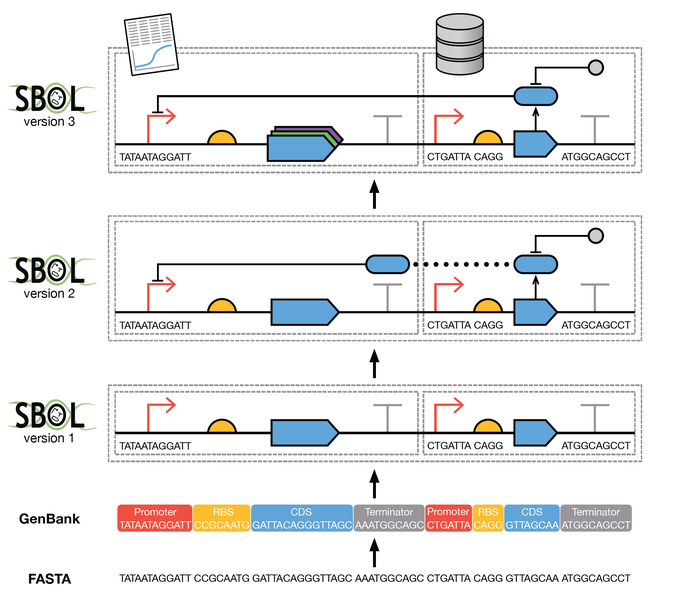
Synthetic biology open language (SBOL) version 3.0.0
Synthetic biology builds upon genetics, molecular biology, and metabolic engineering by applying engineering principles to the design of biological systems. When designing a synthetic system, synthetic biologists need to exchange information about multiple types of molecules, the intended behavior of the system, and…
The Synthetic Biology Open Language (SBOL) Version 3: Simplified Data Exchange for Bioengineering
The Synthetic Biology Open Language (SBOL) is a community-developed data standard that allows knowledge about biological designs to be captured using a machine-tractable, ontology-backed representation that is built using Semantic Web technologies. While early versions of SBOL focused only on the description of…
The Synthetic Biology Open Language (SBOL) Version 3: Simplified Data Exchange for Bioengineering
The Synthetic Biology Open Language (SBOL) is a community-developed data standard that allows knowledge about biological designs to be captured using a machine-tractable, ontology-backed representation that is built using Semantic Web technologies. While early versions of SBOL focused only on the description of…
Synthetic Biology Open Language (SBOL) Version 2.3
textlesssection class=\"abstract\"textgreatertextlessh2 class=\"abstractTitle text-title my-1\" id=\"d230e2\"textgreaterAbstracttextless/h2textgreatertextlessptextgreaterSynthetic biology builds upon the techniques and successes of genetics, molecular biology, and metabolic engineering by applying engineering…
Synthetic Biology Open Language (SBOL) Version 2.3
Synthetic biology builds upon the techniques and successes of genetics, molecular biology, and metabolic engineering by applying engineering principles to the design of biological systems. The field still faces substantial challenges, including long development times, high rates of failure, and poor reproducibility.…
A standard-enabled workflow for synthetic biology
A synthetic biology workflow is composed of data repositories that provide information about genetic parts, sequence-level design tools to compose these parts into circuits, visualization tools to depict these designs, genetic design tools to select parts to create systems, and modeling and simulation tools to evaluate…
A Standard-Enabled Workflow for Synthetic Biology
A synthetic biology workflow is composed of data repositories that provide information about genetic parts, sequence-level design tools to compose these parts into circuits, visualization tools to depict these designs, genetic design tools to select parts to create systems, and modeling and simulation tools to evaluate…
Synthetic Biology Open Language (SBOL) Version 2.1.0
textlesssection class=\"abstract\"textgreatertextlessh2 class=\"abstractTitle text-title my-1\" id=\"d807e2\"textgreaterSummarytextless/h2textgreatertextlessptextgreaterSynthetic biology builds upon the techniques and successes of genetics, molecular biology, and metabolic engineering by applying engineering principles…
Synthetic Biology Open Language (SBOL) Version 2.1.0
Synthetic biology builds upon the techniques and successes of genetics, molecular biology, and metabolic engineering by applying engineering principles to the design of biological systems. The field still faces substantial challenges, including long development times, high rates of failure, and poor reproducibility.…
Sharing Structure and Function in Biological Design with SBOL 2.0
The Synthetic Biology Open Language (SBOL) is a standard that enables collaborative engineering of biological systems across different institutions and tools. SBOL is developed through careful consideration of recent synthetic biology trends, real use cases, and consensus among leading researchers in the field and…
Sharing Structure and Function in Biological Design with SBOL 2.0
The Synthetic Biology Open Language (SBOL) is a standard that enables collaborative engineering of biological systems across different institutions and tools. SBOL is developed through careful consideration of recent synthetic biology trends, real use cases, and consensus among leading researchers in the field and…
libSBOLj 2.0: A Java Library to Support SBOL 2.0
The Synthetic Biology Open Language (SBOL) is an emerging data standard for representing synthetic biology designs. The goal of SBOL is to improve the reproducibility of these designs and their electronic exchange between researchers and/or genetic design automation tools. The latest version of the standard, SBOL 2.0,…
BBF RFC 108: Synthetic Biology Open Language (SBOL) Version 2.0.0
The Synthetic Biology Open Language (SBOL) has been developed as a standard to support the specification and exchange of biological design information in synthetic biology, filling a need not satisfied by other pre-existing standards.
BBF RFC 108: Synthetic Biology Open Language (SBOL) Version 2.0.0
The Synthetic Biology Open Language (SBOL) has been developed as a standard to support the specification and exchange of biological design information in synthetic biology, filling a need not satisfied by other pre-existing standards.
The Synthetic Biology Open Language
The design and construction of engineered organisms is an emerging new discipline called synthetic biology and holds considerable promise as a new technological platform. The design of biologically engineered systems is however nontrivial, requiring contributions from a wide array of disciplines. One particular issue…
The Synthetic Biology Open Language
The design and construction of engineered organisms is an emerging new discipline called synthetic biology and holds considerable promise as a new technological platform. The design of biologically engineered systems is however nontrivial, requiring contributions from a wide array of disciplines. One particular issue…
The Synthetic Biology Open Language (SBOL) provides a community standard for communicating designs in synthetic biology
The synthetic biology research community describes a standard language for exchanging designs of biological 'parts'.
The Synthetic Biology Open Language (SBOL) Provides a Community Standard for Communicating Designs in Synthetic Biology
The synthetic biology research community describes a standard language for exchanging designs of biological 'parts'.
Synthetic Biology Open Language (SBOL) Version 1.1.0
In this BioBricks Foundation Request for Comments (BBF RFC), we specify the Synthetic Biology Open Language (SBOL) Version 1.1.0 to enable the electronic exchange of information describing DNA components used in synthetic biology. We define: 1. the vocabulary, a set of preferred terms and 2. the core data model, a…
Synthetic Biology Open Language (SBOL) Version 1.1.0
In this BioBricks Foundation Request for Comments (BBF RFC), we specify the Synthetic Biology Open Language (SBOL) Version 1.1.0 to enable the electronic exchange of information describing DNA components used in synthetic biology. We define: 1. the vocabulary, a set of preferred terms and 2. the core data model, a…