Jacob Beal
Steering Committee · Raytheon BBN Technologies
Publications and posts
pySBOL3: SBOL3 for Python Programmers
The Synthetic Biology Open Language version 3 (SBOL3) provides a data model for representation of synthetic biology information across multiple scales and throughout the design-build-test-learn workflow. To support practical use of this data model, we have developed pySBOL3, a Python library that allows programmers to…
Intent Parser: A Tool for Codification and Sharing of Experimental Design
Communicating information about experimental design among a team of collaborators is challenging because different people tend to describe experiments in different ways and with different levels of detail. Sometimes, humans can interpret missing information by making assumptions and drawing inferences from information…
Synthetic Biology Curation Tools (SYNBICT)
Much progress has been made in developing tools to generate component-based design representations of biological systems from standard libraries of parts. Most biological designs, however, are still specified at the sequence level. Consequently, there exists a need for a tool that can be used to automatically infer…
Curation Principles Derived from the Analysis of the SBOL iGEM Data Set
As an engineering endeavor, synthetic biology requires effective sharing of genetic design information that can be reused in the construction of new designs. While there are a number of large community repositories of design information, curation of this information has been limited. This in turn limits the ways in…
Synthetic Biology Open Language Visual (SBOL Visual) Version 3.0
People who engineer biological organisms often find it useful to draw diagrams in order to communicate both the structure of the nucleic acid sequences that they are engineering and the functional relationships between sequence features and other molecular species. Some typical practices and conventions have begun to…
Synthetic Biology Open Language Visual (SBOL Visual) Version 2.3
People who are engineering biological organisms often find it useful to communicate in diagrams, both about the structure of the nucleic acid sequences that they are engineering and about the functional relationships between sequence features and other molecular species. Some typical practices and conventions have…
Capturing Multicellular System Designs Using Synthetic Biology Open Language (SBOL)
Synthetic biology aims to develop novel biological systems and increase their reproducibility using engineering principles such as standardization and modularization. It is important that these systems can be represented and shared in a standard way to ensure they can be easily understood, reproduced, and utilized by…
Synthetic Biology Open Language Visual (SBOL Visual) Version 2.2
People who are engineering biological organisms often find it useful to communicate in diagrams, both about the structure of the nucleic acid sequences that they are engineering and about the functional relationships between sequence features and other molecular species. Some typical practices and conventions have…
SBOL Visual 2 Ontology
Standardizing the visual representation of genetic parts and circuits is essential for unambiguously creating and interpreting genetic designs. To this end, an increasing number of tools are adopting well-defined glyphs from the Synthetic Biology Open Language (SBOL) Visual standard to represent various genetic parts…
SBOL Visual 2 Ontology
Standardizing the visual representation of genetic parts and circuits is essential for unambiguously creating and interpreting genetic designs. To this end, an increasing number of tools are adopting well-defined glyphs from the Synthetic Biology Open Language (SBOL) Visual standard to represent various genetic parts…
ShortBOL: A Language for Scripting Designs for Engineered Biological Systems Using Synthetic Biology Open Language (SBOL)
The Synthetic Biology Open Language (SBOL) is an emerging synthetic biology data exchange standard, designed primarily for unambiguous and efficient machine-to-machine communication. However, manual editing of SBOL is generally difficult for nontrivial designs. Here, we describe ShortBOL, a lightweight SBOL scripting…
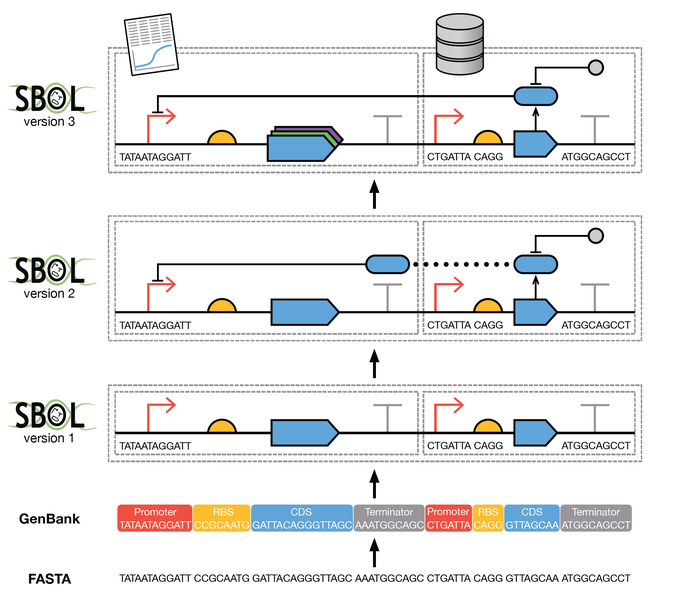
Synthetic biology open language (SBOL) version 3.0.0
Synthetic biology builds upon genetics, molecular biology, and metabolic engineering by applying engineering principles to the design of biological systems. When designing a synthetic system, synthetic biologists need to exchange information about multiple types of molecules, the intended behavior of the system, and…
Synthetic biology open language visual (SBOL visual) version 2.2
People who are engineering biological organisms often find it useful to communicate in diagrams, both about the structure of the nucleic acid sequences that they are engineering and about the functional relationships between sequence features and other molecular species. Some typical practices and conventions have…
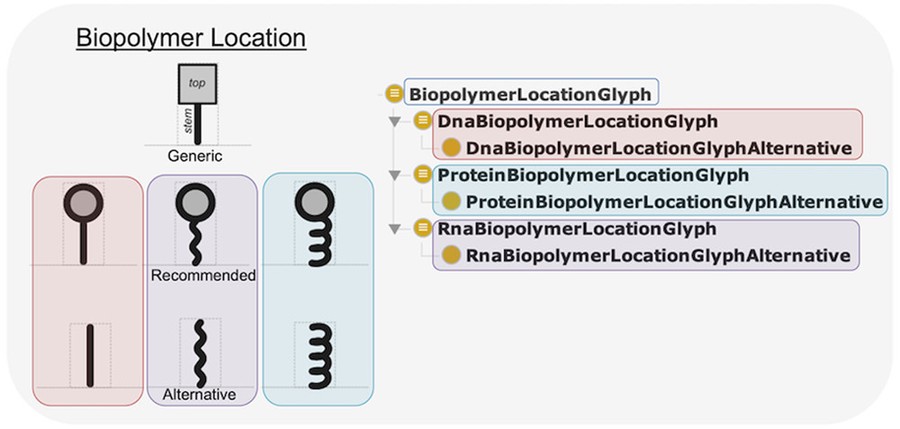
SBOL Visual 2 Ontology
Standardizing the visual representation of genetic parts and circuits is essential for unambiguously creating and interpreting genetic designs. To this end, an increasing number of tools are adopting well-defined glyphs from the Synthetic Biology Open Language (SBOL) Visual standard to represent various genetic parts…
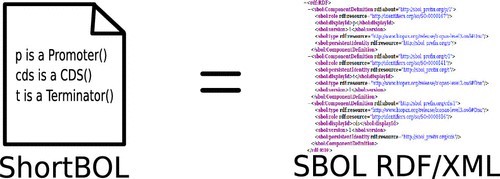
ShortBOL: A Language for Scripting Designs for Engineered Biological Systems Using Synthetic Biology Open Language (SBOL)
The Synthetic Biology Open Language (SBOL) is an emerging synthetic biology data exchange standard, designed primarily for unambiguous and efficient machine-to-machine communication. However, manual editing of SBOL is generally difficult for nontrivial designs. Here, we describe ShortBOL, a lightweight SBOL scripting…
The Synthetic Biology Open Language (SBOL) Version 3: Simplified Data Exchange for Bioengineering
The Synthetic Biology Open Language (SBOL) is a community-developed data standard that allows knowledge about biological designs to be captured using a machine-tractable, ontology-backed representation that is built using Semantic Web technologies. While early versions of SBOL focused only on the description of…
The Synthetic Biology Open Language (SBOL) Version 3: Simplified Data Exchange for Bioengineering
The Synthetic Biology Open Language (SBOL) is a community-developed data standard that allows knowledge about biological designs to be captured using a machine-tractable, ontology-backed representation that is built using Semantic Web technologies. While early versions of SBOL focused only on the description of…
Communicating Structure and Function in Synthetic Biology Diagrams
Biological engineers often find it useful to communicate using diagrams. These diagrams can include information both about the structure of the nucleic acid sequences they are engineering and about the functional relationships between features of these sequences and/or other molecular species. A number of conventions…
Communicating Structure and Function in Synthetic Biology Diagrams
Biological engineers often find it useful to communicate using diagrams. These diagrams can include information both about the structure of the nucleic acid sequences they are engineering and about the functional relationships between features of these sequences and/or other molecular species. A number of conventions…
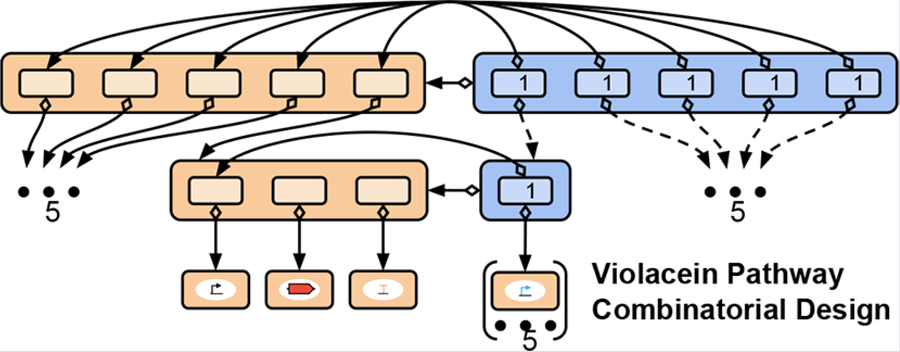
Specifying Combinatorial Designs with the Synthetic Biology Open Language (SBOL)
As improvements in DNA synthesis technology and assembly methods make combinatorial assembly of genetic constructs increasingly accessible, methods for representing genetic constructs likewise need to improve to handle the exponential growth of combinatorial design space. To this end, we present a community accepted…
Specifying Combinatorial Designs with the Synthetic Biology Open Language (SBOL)
As improvements in DNA synthesis technology and assembly methods make combinatorial assembly of genetic constructs increasingly accessible, methods for representing genetic constructs likewise need to improve to handle the exponential growth of combinatorial design space. To this end, we present a community accepted…
Synthetic Biology Open Language (SBOL) Version 2.3
textlesssection class=\"abstract\"textgreatertextlessh2 class=\"abstractTitle text-title my-1\" id=\"d230e2\"textgreaterAbstracttextless/h2textgreatertextlessptextgreaterSynthetic biology builds upon the techniques and successes of genetics, molecular biology, and metabolic engineering by applying engineering…
Synthetic Biology Open Language Visual (SBOL Visual) Version 2.1
Abstract People who are engineering biological organisms often find it useful to communicate in diagrams, both about the structure of the nucleic acid sequences that they are engineering and about the functional relationships between sequence features and other molecular species . Some typical practices and…
Synthetic Biology Open Language (SBOL) Version 2.3
Synthetic biology builds upon the techniques and successes of genetics, molecular biology, and metabolic engineering by applying engineering principles to the design of biological systems. The field still faces substantial challenges, including long development times, high rates of failure, and poor reproducibility.…
Synthetic Biology Open Language Visual (SBOL Visual) Version 2.1
People who are engineering biological organisms often find it useful to communicate in diagrams, both about the structure of the nucleic acid sequences that they are engineering and about the functional relationships between sequence features and other molecular species . Some typical practices and conventions have…
A Visual Language for Protein Design
As protein engineering becomes more sophisticated, practitioners increasingly need to share diagrams for communicating protein designs. To this end, we present a draft visual language, Protein Language, that describes the high-level architecture of an engineered protein with easy-to-draw glyphs, intended to be…
A Visual Language for Protein Design
As protein engineering becomes more sophisticated, practitioners increasingly need to share diagrams for communicating protein designs. To this end, we present a draft visual language, Protein Language, that describes the high-level architecture of an engineered protein with easy-to-draw glyphs, intended to be…
A standard-enabled workflow for synthetic biology
A synthetic biology workflow is composed of data repositories that provide information about genetic parts, sequence-level design tools to compose these parts into circuits, visualization tools to depict these designs, genetic design tools to select parts to create systems, and modeling and simulation tools to evaluate…
A Standard-Enabled Workflow for Synthetic Biology
A synthetic biology workflow is composed of data repositories that provide information about genetic parts, sequence-level design tools to compose these parts into circuits, visualization tools to depict these designs, genetic design tools to select parts to create systems, and modeling and simulation tools to evaluate…
Synthetic Biology Open Language (SBOL) Version 2.1.0
textlesssection class=\"abstract\"textgreatertextlessh2 class=\"abstractTitle text-title my-1\" id=\"d807e2\"textgreaterSummarytextless/h2textgreatertextlessptextgreaterSynthetic biology builds upon the techniques and successes of genetics, molecular biology, and metabolic engineering by applying engineering principles…
Synthetic Biology Open Language (SBOL) Version 2.1.0
Synthetic biology builds upon the techniques and successes of genetics, molecular biology, and metabolic engineering by applying engineering principles to the design of biological systems. The field still faces substantial challenges, including long development times, high rates of failure, and poor reproducibility.…
Improving Synthetic Biology Communication: Recommended Practices for Visual Depiction and Digital Submission of Genetic Designs
Research is communicated more effectively and reproducibly when articles depict genetic designs consistently and fully disclose the complete sequences of all reported constructs. ACS Synthetic Biology is now providing authors with updated guidance and piloting a new tool and publication workflow that facilitate…
Sharing Structure and Function in Biological Design with SBOL 2.0
The Synthetic Biology Open Language (SBOL) is a standard that enables collaborative engineering of biological systems across different institutions and tools. SBOL is developed through careful consideration of recent synthetic biology trends, real use cases, and consensus among leading researchers in the field and…
Improving Synthetic Biology Communication: Recommended Practices for Visual Depiction and Digital Submission of Genetic Designs
Research is communicated more effectively and reproducibly when articles depict genetic designs consistently and fully disclose the complete sequences of all reported constructs. ACS Synthetic Biology is now providing authors with updated guidance and piloting a new tool and publication workflow that facilitate…
Sharing Structure and Function in Biological Design with SBOL 2.0
The Synthetic Biology Open Language (SBOL) is a standard that enables collaborative engineering of biological systems across different institutions and tools. SBOL is developed through careful consideration of recent synthetic biology trends, real use cases, and consensus among leading researchers in the field and…
SBOL Visual: A Graphical Language for Genetic Designs
Synthetic Biology Open Language (SBOL) Visual is a graphical standard for genetic engineering. It consists of symbols representing DNA subsequences, including regulatory elements and DNA assembly features. These symbols can be used to draw illustrations for communication and instruction, and as image assets for…
libSBOLj 2.0: A Java Library to Support SBOL 2.0
The Synthetic Biology Open Language (SBOL) is an emerging data standard for representing synthetic biology designs. The goal of SBOL is to improve the reproducibility of these designs and their electronic exchange between researchers and/or genetic design automation tools. The latest version of the standard, SBOL 2.0,…
SBOL Visual: A Graphical Language for Genetic Designs
Synthetic Biology Open Language (SBOL) Visual is a graphical standard for genetic engineering. It consists of symbols representing DNA subsequences, including regulatory elements and DNA assembly features. These symbols can be used to draw illustrations for communication and instruction, and as image assets for…
BBF RFC 108: Synthetic Biology Open Language (SBOL) Version 2.0.0
The Synthetic Biology Open Language (SBOL) has been developed as a standard to support the specification and exchange of biological design information in synthetic biology, filling a need not satisfied by other pre-existing standards.
BBF RFC 108: Synthetic Biology Open Language (SBOL) Version 2.0.0
The Synthetic Biology Open Language (SBOL) has been developed as a standard to support the specification and exchange of biological design information in synthetic biology, filling a need not satisfied by other pre-existing standards.
The Synthetic Biology Open Language (SBOL) provides a community standard for communicating designs in synthetic biology
The synthetic biology research community describes a standard language for exchanging designs of biological 'parts'.
The Synthetic Biology Open Language (SBOL) Provides a Community Standard for Communicating Designs in Synthetic Biology
The synthetic biology research community describes a standard language for exchanging designs of biological 'parts'.
Synthetic Biology Open Language (SBOL) Version 1.1.0
In this BioBricks Foundation Request for Comments (BBF RFC), we specify the Synthetic Biology Open Language (SBOL) Version 1.1.0 to enable the electronic exchange of information describing DNA components used in synthetic biology. We define: 1. the vocabulary, a set of preferred terms and 2. the core data model, a…
Synthetic Biology Open Language (SBOL) Version 1.1.0
In this BioBricks Foundation Request for Comments (BBF RFC), we specify the Synthetic Biology Open Language (SBOL) Version 1.1.0 to enable the electronic exchange of information describing DNA components used in synthetic biology. We define: 1. the vocabulary, a set of preferred terms and 2. the core data model, a…
An End-to-End Workflow for Engineering of Biological Networks from High-Level Specifications
We present a workflow for the design and production of biological networks from high-level program specifications. The workflow is based on a sequence of intermediate models that incrementally translate high-level specifications into DNA samples that implement them. We identify algorithms for translating between…
Automated Selection of Synthetic Biology Parts for Genetic Regulatory Networks
Raising the level of abstraction for synthetic biology design requires solving several challenging problems, including mapping abstract designs to DNA sequences. In this paper we present the first formalism and algorithms to address this problem. The key steps of this transformation are feature matching, signal…
An End-to-End Workflow for Engineering of Biological Networks from High-Level Specifications
We present a workflow for the design and production of biological networks from high-level program specifications. The workflow is based on a sequence of intermediate models that incrementally translate high-level specifications into DNA samples that implement them. We identify algorithms for translating between…
Automated Selection of Synthetic Biology Parts for Genetic Regulatory Networks
Raising the level of abstraction for synthetic biology design requires solving several challenging problems, including mapping abstract designs to DNA sequences. In this paper we present the first formalism and algorithms to address this problem. The key steps of this transformation are feature matching, signal…
Title: Synthetic Biology Open Language (SBOL) Version 1.0.0
In this BioBricks Foundation Request for Comments (BBF RFC), we specify the Synthetic Biology Open Language (SBOL) Version 1.0.0 to enable the electronic exchange of information describing DNA components used in synthetic biology. We define: 1. the vocabulary, a set of preferred terms and 2. the core data…
Title: Synthetic Biology Open Language (SBOL) Version 1.0.0
In this BioBricks Foundation Request for Comments (BBF RFC), we specify the Synthetic Biology Open Language (SBOL) Version 1.0.0 to enable the electronic exchange of information describing DNA components used in synthetic biology. We define: 1. the vocabulary, a set of preferred terms and 2. the core data…