Jennifer Hallinan
Publications and posts
Data Integration and Mining for Synthetic Biology Design
One aim of synthetic biologists is to create novel and predictable biological systems from simpler modular parts. This approach is currently hampered by a lack of well-defined and characterized parts and devices. However, there is a wealth of existing biological information, which can be used to identify and…
Data Integration and Mining for Synthetic Biology Design
One aim of synthetic biologists is to create novel and predictable biological systems from simpler modular parts. This approach is currently hampered by a lack of well-defined and characterized parts and devices. However, there is a wealth of existing biological information, which can be used to identify and…
The SBOL Stack: A Platform for Storing, Publishing, and Sharing Synthetic Biology Designs
Recently, synthetic biologists have developed the Synthetic Biology Open Language (SBOL), a data exchange standard for descriptions of genetic parts, devices, modules, and systems. The goals of this standard are to allow scientists to exchange designs of biological parts and systems, to facilitate the storage of…
The SBOL Stack: A Platform for Storing, Publishing, and Sharing Synthetic Biology Designs
Recently, synthetic biologists have developed the Synthetic Biology Open Language (SBOL), a data exchange standard for descriptions of genetic parts, devices, modules, and systems. The goals of this standard are to allow scientists to exchange designs of biological parts and systems, to facilitate the storage of…
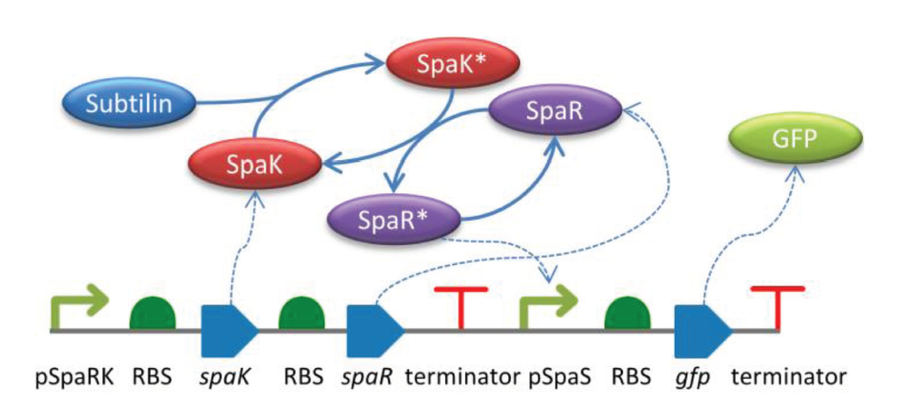
Composable Modular Models for Synthetic Biology
Modelling and computational simulation are crucial for the large-scale engineering of biological circuits since they allow the system under design to be simulated prior to implementation in vivo. To support automated, model-driven design it is desirable that in silico models are modular, composable and use standard…
The Synthetic Biology Open Language (SBOL) provides a community standard for communicating designs in synthetic biology
The synthetic biology research community describes a standard language for exchanging designs of biological 'parts'.
The Synthetic Biology Open Language (SBOL) Provides a Community Standard for Communicating Designs in Synthetic Biology
The synthetic biology research community describes a standard language for exchanging designs of biological 'parts'.