Pedro Fontanarrosa
Former SBOL Editor · University of Utah
Publications and posts
Stochastic Hazard Analysis of Genetic Circuits in iBioSim and STAMINA
In synthetic biology, combinational circuits are used to program cells for various new applications like biosensors, drug delivery systems, and biofuels. Similar to asynchronous electronic circuits, some combinational genetic circuits may show unwanted switching variations (glitches) caused by multiple input changes.…
Synthetic Biology Open Language Visual (SBOL Visual) Version 3.0
People who engineer biological organisms often find it useful to draw diagrams in order to communicate both the structure of the nucleic acid sequences that they are engineering and the functional relationships between sequence features and other molecular species. Some typical practices and conventions have begun to…
Synthetic Biology Open Language Visual (SBOL Visual) Version 2.3
People who are engineering biological organisms often find it useful to communicate in diagrams, both about the structure of the nucleic acid sequences that they are engineering and about the functional relationships between sequence features and other molecular species. Some typical practices and conventions have…
Genetic Circuit Dynamics: Hazard and Glitch Analysis
Multiple input changes can cause unwanted switching variations, or glitches, in the output of genetic combinational circuits. These glitches can have drastic effects if the output of the circuit causes irreversible changes within or with other cells such as a cascade of responses, apoptosis, or the release of a…
Synthetic Biology Open Language Visual (SBOL Visual) Version 2.2
People who are engineering biological organisms often find it useful to communicate in diagrams, both about the structure of the nucleic acid sequences that they are engineering and about the functional relationships between sequence features and other molecular species. Some typical practices and conventions have…
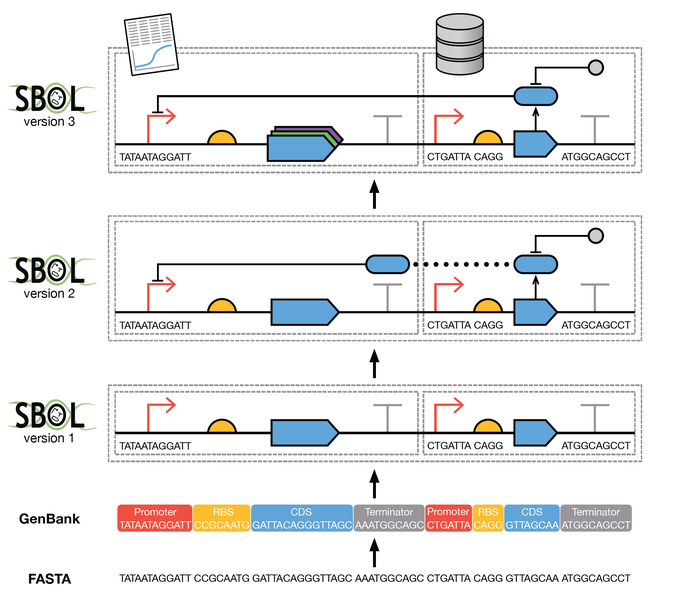
Synthetic biology open language (SBOL) version 3.0.0
Synthetic biology builds upon genetics, molecular biology, and metabolic engineering by applying engineering principles to the design of biological systems. When designing a synthetic system, synthetic biologists need to exchange information about multiple types of molecules, the intended behavior of the system, and…
Synthetic biology open language visual (SBOL visual) version 2.2
People who are engineering biological organisms often find it useful to communicate in diagrams, both about the structure of the nucleic acid sequences that they are engineering and about the functional relationships between sequence features and other molecular species. Some typical practices and conventions have…
The Synthetic Biology Open Language (SBOL) Version 3: Simplified Data Exchange for Bioengineering
The Synthetic Biology Open Language (SBOL) is a community-developed data standard that allows knowledge about biological designs to be captured using a machine-tractable, ontology-backed representation that is built using Semantic Web technologies. While early versions of SBOL focused only on the description of…
The Synthetic Biology Open Language (SBOL) Version 3: Simplified Data Exchange for Bioengineering
The Synthetic Biology Open Language (SBOL) is a community-developed data standard that allows knowledge about biological designs to be captured using a machine-tractable, ontology-backed representation that is built using Semantic Web technologies. While early versions of SBOL focused only on the description of…
Design of Asynchronous Genetic Circuits
Most digital electronic circuits utilize a timing reference to synchronize the progression of signals and enable sequential memory elements. These designs may not be realizable in biological substrates due to the lack of a reliable high-frequency clock signal. Asynchronous designs eliminate the need for a clock with…
Design of Asynchronous Genetic Circuits
Most digital electronic circuits utilize a timing reference to synchronize the progression of signals and enable sequential memory elements. These designs may not be realizable in biological substrates due to the lack of a reliable high-frequency clock signal. Asynchronous designs eliminate the need for a clock with…