Prashant Vaidyanathan
SBOL Chair (2023–present) · Oxford Biomedica
Publications and posts
SBOLinside: Episode 1 with Prof. Herbert Sauro
Go inside the genesis of the Synthetic Biology Open Language standard with Prof. Herbert Sauro in our inaugural video podcast episode.
Welcome to the SBOL Blog
Introducing the new SBOL community blog — a space for developers, researchers, and users to share insights, tutorials, and updates from across the synthetic biology community.
Synthetic Biology Open Language Visual (SBOL Visual) Version 3.0
People who engineer biological organisms often find it useful to draw diagrams in order to communicate both the structure of the nucleic acid sequences that they are engineering and the functional relationships between sequence features and other molecular species. Some typical practices and conventions have begun to…
Synthetic Biology Open Language Visual (SBOL Visual) Version 2.3
People who are engineering biological organisms often find it useful to communicate in diagrams, both about the structure of the nucleic acid sequences that they are engineering and about the functional relationships between sequence features and other molecular species. Some typical practices and conventions have…
Synthetic Biology Open Language Visual (SBOL Visual) Version 2.2
People who are engineering biological organisms often find it useful to communicate in diagrams, both about the structure of the nucleic acid sequences that they are engineering and about the functional relationships between sequence features and other molecular species. Some typical practices and conventions have…
Synthetic biology open language (SBOL) version 3.0.0
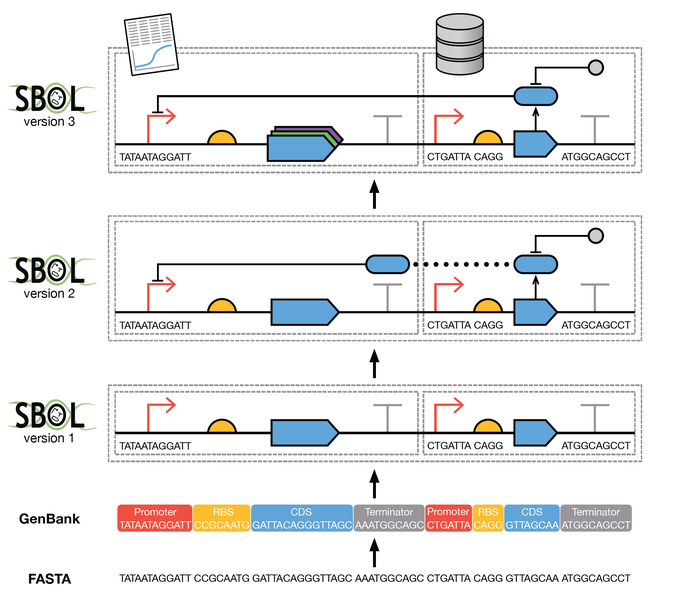
Synthetic biology builds upon genetics, molecular biology, and metabolic engineering by applying engineering principles to the design of biological systems. When designing a synthetic system, synthetic biologists need to exchange information about multiple types of molecules, the intended behavior of the system, and…
Synthetic biology open language visual (SBOL visual) version 2.2
People who are engineering biological organisms often find it useful to communicate in diagrams, both about the structure of the nucleic acid sequences that they are engineering and about the functional relationships between sequence features and other molecular species. Some typical practices and conventions have…
The Synthetic Biology Open Language (SBOL) Version 3: Simplified Data Exchange for Bioengineering
The Synthetic Biology Open Language (SBOL) is a community-developed data standard that allows knowledge about biological designs to be captured using a machine-tractable, ontology-backed representation that is built using Semantic Web technologies. While early versions of SBOL focused only on the description of…
The Synthetic Biology Open Language (SBOL) Version 3: Simplified Data Exchange for Bioengineering
The Synthetic Biology Open Language (SBOL) is a community-developed data standard that allows knowledge about biological designs to be captured using a machine-tractable, ontology-backed representation that is built using Semantic Web technologies. While early versions of SBOL focused only on the description of…
A Computational Workflow for the Automated Generation of Models of Genetic Designs
Computational models are essential to engineer predictable biological systems and to scale up this process for complex systems. Computational modeling often requires expert knowledge and data to build models. Clearly, manual creation of models is not scalable for large designs. Despite several automated model…
A Computational Workflow for the Automated Generation of Models of Genetic Designs
Computational models are essential to engineer predictable biological systems and to scale up this process for complex systems. Computational modeling often requires expert knowledge and data to build models. Clearly, manual creation of models is not scalable for large designs. Despite several automated model…