Raik Grünberg
Former SBOL Editor · University of Montreal
Publications and posts
Synthetic Biology Open Language Visual (SBOL Visual) Version 2.3
People who are engineering biological organisms often find it useful to communicate in diagrams, both about the structure of the nucleic acid sequences that they are engineering and about the functional relationships between sequence features and other molecular species. Some typical practices and conventions have…
Synthetic Biology Open Language Visual (SBOL Visual) Version 2.2
People who are engineering biological organisms often find it useful to communicate in diagrams, both about the structure of the nucleic acid sequences that they are engineering and about the functional relationships between sequence features and other molecular species. Some typical practices and conventions have…
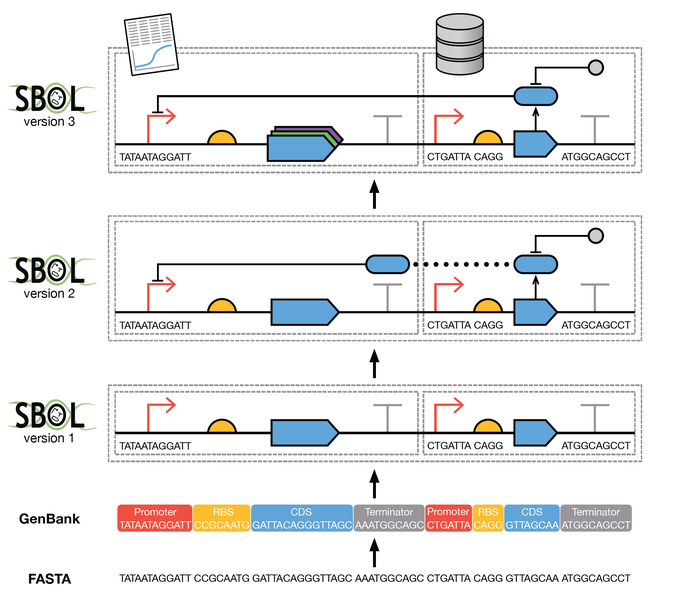
Synthetic biology open language (SBOL) version 3.0.0
Synthetic biology builds upon genetics, molecular biology, and metabolic engineering by applying engineering principles to the design of biological systems. When designing a synthetic system, synthetic biologists need to exchange information about multiple types of molecules, the intended behavior of the system, and…
Synthetic biology open language visual (SBOL visual) version 2.2
People who are engineering biological organisms often find it useful to communicate in diagrams, both about the structure of the nucleic acid sequences that they are engineering and about the functional relationships between sequence features and other molecular species. Some typical practices and conventions have…
The Synthetic Biology Open Language (SBOL) Version 3: Simplified Data Exchange for Bioengineering
The Synthetic Biology Open Language (SBOL) is a community-developed data standard that allows knowledge about biological designs to be captured using a machine-tractable, ontology-backed representation that is built using Semantic Web technologies. While early versions of SBOL focused only on the description of…
The Synthetic Biology Open Language (SBOL) Version 3: Simplified Data Exchange for Bioengineering
The Synthetic Biology Open Language (SBOL) is a community-developed data standard that allows knowledge about biological designs to be captured using a machine-tractable, ontology-backed representation that is built using Semantic Web technologies. While early versions of SBOL focused only on the description of…
Synthetic Biology Open Language (SBOL) Version 2.3
textlesssection class=\"abstract\"textgreatertextlessh2 class=\"abstractTitle text-title my-1\" id=\"d230e2\"textgreaterAbstracttextless/h2textgreatertextlessptextgreaterSynthetic biology builds upon the techniques and successes of genetics, molecular biology, and metabolic engineering by applying engineering…
Synthetic Biology Open Language Visual (SBOL Visual) Version 2.1
Abstract People who are engineering biological organisms often find it useful to communicate in diagrams, both about the structure of the nucleic acid sequences that they are engineering and about the functional relationships between sequence features and other molecular species . Some typical practices and…
Synthetic Biology Open Language (SBOL) Version 2.3
Synthetic biology builds upon the techniques and successes of genetics, molecular biology, and metabolic engineering by applying engineering principles to the design of biological systems. The field still faces substantial challenges, including long development times, high rates of failure, and poor reproducibility.…
Synthetic Biology Open Language Visual (SBOL Visual) Version 2.1
People who are engineering biological organisms often find it useful to communicate in diagrams, both about the structure of the nucleic acid sequences that they are engineering and about the functional relationships between sequence features and other molecular species . Some typical practices and conventions have…
A Visual Language for Protein Design
As protein engineering becomes more sophisticated, practitioners increasingly need to share diagrams for communicating protein designs. To this end, we present a draft visual language, Protein Language, that describes the high-level architecture of an engineered protein with easy-to-draw glyphs, intended to be…
A Visual Language for Protein Design
As protein engineering becomes more sophisticated, practitioners increasingly need to share diagrams for communicating protein designs. To this end, we present a draft visual language, Protein Language, that describes the high-level architecture of an engineered protein with easy-to-draw glyphs, intended to be…
SBOLme: a Repository of SBOL Parts for Metabolic Engineering
The Synthetic Biology Open Language (SBOL) is a community-driven open language to promote standardization in synthetic biology. To support the use of SBOL in metabolic engineering, we developed SBOLme, the first open-access repository of SBOL 2-compliant biochemical parts for a wide range of metabolic engineering…
SBOLme: A Repository of SBOL Parts for Metabolic Engineering
The Synthetic Biology Open Language (SBOL) is a community-driven open language to promote standardization in synthetic biology. To support the use of SBOL in metabolic engineering, we developed SBOLme, the first open-access repository of SBOL 2-compliant biochemical parts for a wide range of metabolic engineering…
Synthetic Biology Open Language (SBOL) Version 2.1.0
textlesssection class=\"abstract\"textgreatertextlessh2 class=\"abstractTitle text-title my-1\" id=\"d807e2\"textgreaterSummarytextless/h2textgreatertextlessptextgreaterSynthetic biology builds upon the techniques and successes of genetics, molecular biology, and metabolic engineering by applying engineering principles…
Synthetic Biology Open Language (SBOL) Version 2.1.0
Synthetic biology builds upon the techniques and successes of genetics, molecular biology, and metabolic engineering by applying engineering principles to the design of biological systems. The field still faces substantial challenges, including long development times, high rates of failure, and poor reproducibility.…
Sharing Structure and Function in Biological Design with SBOL 2.0
The Synthetic Biology Open Language (SBOL) is a standard that enables collaborative engineering of biological systems across different institutions and tools. SBOL is developed through careful consideration of recent synthetic biology trends, real use cases, and consensus among leading researchers in the field and…
Sharing Structure and Function in Biological Design with SBOL 2.0
The Synthetic Biology Open Language (SBOL) is a standard that enables collaborative engineering of biological systems across different institutions and tools. SBOL is developed through careful consideration of recent synthetic biology trends, real use cases, and consensus among leading researchers in the field and…
The Synthetic Biology Open Language (SBOL) provides a community standard for communicating designs in synthetic biology
The synthetic biology research community describes a standard language for exchanging designs of biological 'parts'.
The Synthetic Biology Open Language (SBOL) Provides a Community Standard for Communicating Designs in Synthetic Biology
The synthetic biology research community describes a standard language for exchanging designs of biological 'parts'.
Synthetic Biology Open Language (SBOL) Version 1.1.0
In this BioBricks Foundation Request for Comments (BBF RFC), we specify the Synthetic Biology Open Language (SBOL) Version 1.1.0 to enable the electronic exchange of information describing DNA components used in synthetic biology. We define: 1. the vocabulary, a set of preferred terms and 2. the core data model, a…
Synthetic Biology Open Language (SBOL) Version 1.1.0
In this BioBricks Foundation Request for Comments (BBF RFC), we specify the Synthetic Biology Open Language (SBOL) Version 1.1.0 to enable the electronic exchange of information describing DNA components used in synthetic biology. We define: 1. the vocabulary, a set of preferred terms and 2. the core data model, a…
Title: Synthetic Biology Open Language (SBOL) Version 1.0.0
In this BioBricks Foundation Request for Comments (BBF RFC), we specify the Synthetic Biology Open Language (SBOL) Version 1.0.0 to enable the electronic exchange of information describing DNA components used in synthetic biology. We define: 1. the vocabulary, a set of preferred terms and 2. the core data…
Title: Synthetic Biology Open Language (SBOL) Version 1.0.0
In this BioBricks Foundation Request for Comments (BBF RFC), we specify the Synthetic Biology Open Language (SBOL) Version 1.0.0 to enable the electronic exchange of information describing DNA components used in synthetic biology. We define: 1. the vocabulary, a set of preferred terms and 2. the core data…
Provisional BioBrick Language (PoBoL)
This BioBricks Foundation Request for Comments (BBF RFC) describes a semantic markup language for publishing and sharing information about BioBricks on the World Wide Web. This BBF RFC includes the recommendation for the minimal information expected when creating a Provisional BioBrick Language (PoBoL) description of…
Provisional BioBrick Language (PoBoL)
This BioBricks Foundation Request for Comments (BBF RFC) describes a semantic markup language for publishing and sharing information about BioBricks on the World Wide Web. This BBF RFC includes the recommendation for the minimal information expected when creating a Provisional BioBrick Language (PoBoL) description of…
BBF RFC 30: Draft of an RDF-based framework for the exchange and integration of Synthetic Biology data
This Request for Comments (RFC) suggests a framework for the description, exchange and interlinking of Synthetic Biology data. The framework would create an open process for the evolution and “rolling” standardization of data models. It describes how data and data models are to be published, how they are…
BBF RFC 30: Draft of an RDF-based Framework for the Exchange and Integration of Synthetic Biology Data
This Request for Comments (RFC) suggests a framework for the description, exchange and interlinking of Synthetic Biology data. The framework would create an open process for the evolution and ``rolling'' standardization of data models. It describes how data and data models are to be published, how they are…