Zach Zundel
Publications and posts
Synthetic Biology Open Language Visual (SBOL Visual) Version 2.3
People who are engineering biological organisms often find it useful to communicate in diagrams, both about the structure of the nucleic acid sequences that they are engineering and about the functional relationships between sequence features and other molecular species. Some typical practices and conventions have…
Synthetic Biology Open Language Visual (SBOL Visual) Version 2.2
People who are engineering biological organisms often find it useful to communicate in diagrams, both about the structure of the nucleic acid sequences that they are engineering and about the functional relationships between sequence features and other molecular species. Some typical practices and conventions have…
Extending SynBioHub's Functionality with Plugins
SynBioHub is a repository for synthetic genetic designs represented in the Synthetic Biology Open Language (SBOL). To integrate SynBioHub into more synthetic biology workflows, its data processing capabilities need to be expanded. To this end, a plugin interface has been developed. Plugins can be developed for data…
Synthetic biology open language visual (SBOL visual) version 2.2
People who are engineering biological organisms often find it useful to communicate in diagrams, both about the structure of the nucleic acid sequences that they are engineering and about the functional relationships between sequence features and other molecular species. Some typical practices and conventions have…
Communicating Structure and Function in Synthetic Biology Diagrams
Biological engineers often find it useful to communicate using diagrams. These diagrams can include information both about the structure of the nucleic acid sequences they are engineering and about the functional relationships between features of these sequences and/or other molecular species. A number of conventions…
Communicating Structure and Function in Synthetic Biology Diagrams
Biological engineers often find it useful to communicate using diagrams. These diagrams can include information both about the structure of the nucleic acid sequences they are engineering and about the functional relationships between features of these sequences and/or other molecular species. A number of conventions…
pySBOL: A Python Package for Genetic Design Automation and Standardization
This paper presents pySBOL, a software library for computer-aided design of synthetic biological systems in the Python scripting language. This library provides an easy-to-use, object-oriented, application programming interface (API) with low barrier of entry for synthetic biology application developers. The pySBOL…
Specifying Combinatorial Designs with the Synthetic Biology Open Language (SBOL)
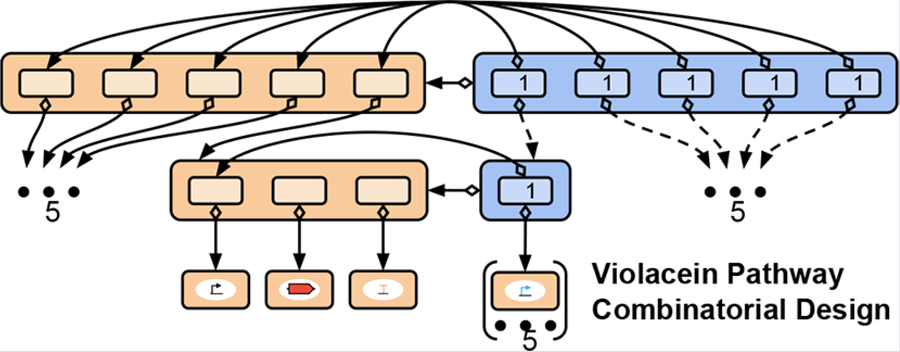
As improvements in DNA synthesis technology and assembly methods make combinatorial assembly of genetic constructs increasingly accessible, methods for representing genetic constructs likewise need to improve to handle the exponential growth of combinatorial design space. To this end, we present a community accepted…
Design of Asynchronous Genetic Circuits
Most digital electronic circuits utilize a timing reference to synchronize the progression of signals and enable sequential memory elements. These designs may not be realizable in biological substrates due to the lack of a reliable high-frequency clock signal. Asynchronous designs eliminate the need for a clock with…
Design of Asynchronous Genetic Circuits
Most digital electronic circuits utilize a timing reference to synchronize the progression of signals and enable sequential memory elements. These designs may not be realizable in biological substrates due to the lack of a reliable high-frequency clock signal. Asynchronous designs eliminate the need for a clock with…
pySBOL: A Python Package for Genetic Design Automation and Standardization
This paper presents pySBOL, a software library for computer-aided design of synthetic biological systems in the Python scripting language. This library provides an easy-to-use, object-oriented, application programming interface (API) with low barrier of entry for synthetic biology application developers. The pySBOL…
Specifying Combinatorial Designs with the Synthetic Biology Open Language (SBOL)
As improvements in DNA synthesis technology and assembly methods make combinatorial assembly of genetic constructs increasingly accessible, methods for representing genetic constructs likewise need to improve to handle the exponential growth of combinatorial design space. To this end, we present a community accepted…
Synthetic Biology Open Language (SBOL) Version 2.3
textlesssection class=\"abstract\"textgreatertextlessh2 class=\"abstractTitle text-title my-1\" id=\"d230e2\"textgreaterAbstracttextless/h2textgreatertextlessptextgreaterSynthetic biology builds upon the techniques and successes of genetics, molecular biology, and metabolic engineering by applying engineering…
Synthetic Biology Open Language Visual (SBOL Visual) Version 2.1
Abstract People who are engineering biological organisms often find it useful to communicate in diagrams, both about the structure of the nucleic acid sequences that they are engineering and about the functional relationships between sequence features and other molecular species . Some typical practices and…
Synthetic Biology Open Language (SBOL) Version 2.3
Synthetic biology builds upon the techniques and successes of genetics, molecular biology, and metabolic engineering by applying engineering principles to the design of biological systems. The field still faces substantial challenges, including long development times, high rates of failure, and poor reproducibility.…
Synthetic Biology Open Language Visual (SBOL Visual) Version 2.1
People who are engineering biological organisms often find it useful to communicate in diagrams, both about the structure of the nucleic acid sequences that they are engineering and about the functional relationships between sequence features and other molecular species . Some typical practices and conventions have…
sboljs: Bringing the Synthetic Biology Open Language to the Web Browser
The Synthetic Biology Open Language (SBOL) is a data standard for the representation of engineered biological systems. SBOL is implemented in the form of software libraries which can be used to add SBOL support to both new and existing software tools. While existing libraries allow for software to be developed that…
Sboljs: Bringing the Synthetic Biology Open Language to the Web Browser
The Synthetic Biology Open Language (SBOL) is a data standard for the representation of engineered biological systems. SBOL is implemented in the form of software libraries which can be used to add SBOL support to both new and existing software tools. While existing libraries allow for software to be developed that…
SynBioHub: A Standards-Enabled Design Repository for Synthetic Biology
The SynBioHub repository (https://synbiohub.org) is an open-source software project that facilitates the sharing of information about engineered biological systems. SynBioHub provides computational access for software and data integration, and a graphical user interface that enables users to search for and share…
SynBioHub: A Standards-Enabled Design Repository for Synthetic Biology
The SynBioHub repository (https://synbiohub.org) is an open-source software project that facilitates the sharing of information about engineered biological systems. SynBioHub provides computational access for software and data integration, and a graphical user interface that enables users to search for and share…
A Validator and Converter for the Synthetic Biology Open Language
This paper presents a new validation and conversion utility for the Synthetic Biology Open Language (SBOL). This utility can be accessed directly in software using the libSBOLj library, through a web interface, or using a web service via RESTful API calls. The validator checks all required and best practice rules set…
A Validator and Converter for the Synthetic Biology Open Language
This paper presents a new validation and conversion utility for the Synthetic Biology Open Language (SBOL). This utility can be accessed directly in software using the libSBOLj library, through a web interface, or using a web service via RESTful API calls. The validator checks all required and best practice rules set…
A standard-enabled workflow for synthetic biology
A synthetic biology workflow is composed of data repositories that provide information about genetic parts, sequence-level design tools to compose these parts into circuits, visualization tools to depict these designs, genetic design tools to select parts to create systems, and modeling and simulation tools to evaluate…
A Standard-Enabled Workflow for Synthetic Biology
A synthetic biology workflow is composed of data repositories that provide information about genetic parts, sequence-level design tools to compose these parts into circuits, visualization tools to depict these designs, genetic design tools to select parts to create systems, and modeling and simulation tools to evaluate…
Synthetic Biology Open Language (SBOL) Version 2.1.0
textlesssection class=\"abstract\"textgreatertextlessh2 class=\"abstractTitle text-title my-1\" id=\"d807e2\"textgreaterSummarytextless/h2textgreatertextlessptextgreaterSynthetic biology builds upon the techniques and successes of genetics, molecular biology, and metabolic engineering by applying engineering principles…
Synthetic Biology Open Language (SBOL) Version 2.1.0
Synthetic biology builds upon the techniques and successes of genetics, molecular biology, and metabolic engineering by applying engineering principles to the design of biological systems. The field still faces substantial challenges, including long development times, high rates of failure, and poor reproducibility.…
A Converter from the Systems Biology Markup Language to the Synthetic Biology Open Language
Standards are important to synthetic biology because they enable exchange and reproducibility of genetic designs. This paper describes a procedure for converting between two standards: the Systems Biology Markup Language (SBML) and the Synthetic Biology Open Language (SBOL). SBML is a standard for behavioral models of…
Sharing Structure and Function in Biological Design with SBOL 2.0
The Synthetic Biology Open Language (SBOL) is a standard that enables collaborative engineering of biological systems across different institutions and tools. SBOL is developed through careful consideration of recent synthetic biology trends, real use cases, and consensus among leading researchers in the field and…
A Converter from the Systems Biology Markup Language to the Synthetic Biology Open Language
Standards are important to synthetic biology because they enable exchange and reproducibility of genetic designs. This paper describes a procedure for converting between two standards: the Systems Biology Markup Language (SBML) and the Synthetic Biology Open Language (SBOL). SBML is a standard for behavioral models of…
Sharing Structure and Function in Biological Design with SBOL 2.0
The Synthetic Biology Open Language (SBOL) is a standard that enables collaborative engineering of biological systems across different institutions and tools. SBOL is developed through careful consideration of recent synthetic biology trends, real use cases, and consensus among leading researchers in the field and…
libSBOLj 2.0: A Java Library to Support SBOL 2.0
The Synthetic Biology Open Language (SBOL) is an emerging data standard for representing synthetic biology designs. The goal of SBOL is to improve the reproducibility of these designs and their electronic exchange between researchers and/or genetic design automation tools. The latest version of the standard, SBOL 2.0,…